


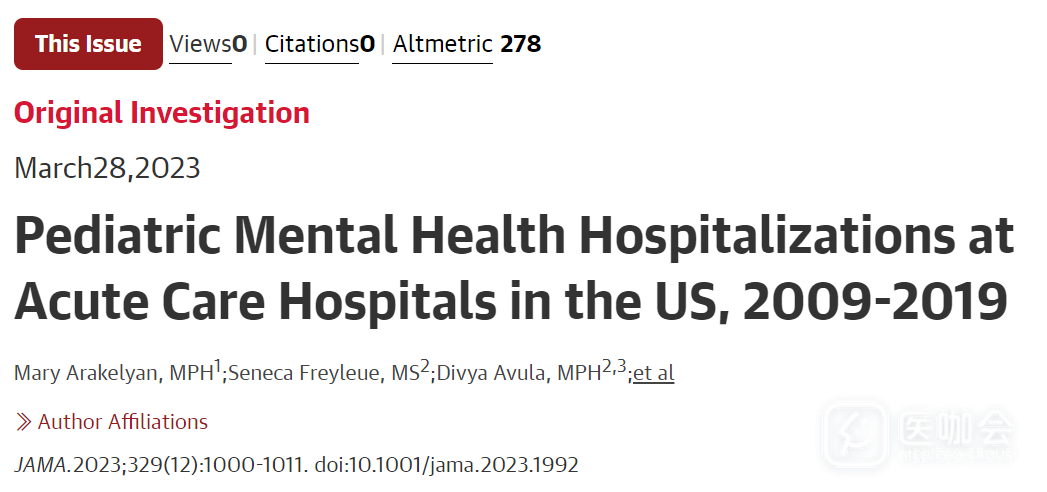
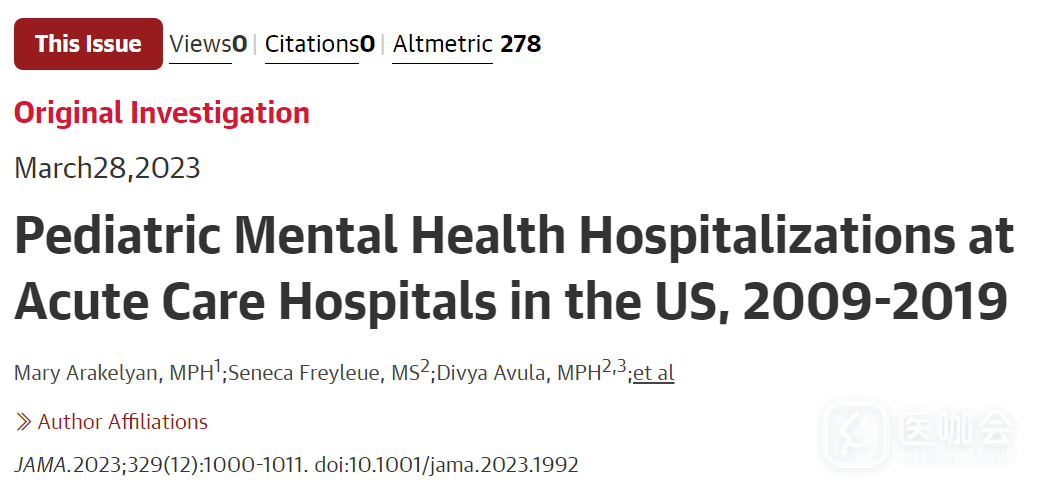
JAMA:2009-2019年美国急症护理医院的儿科精神健康住院情况
注:本文由小咖机器人翻译整理
期刊来源:JAMA
文献发表时间:2023-03-28
原文链接:https://jamanetwork.com/journals/jama/article-abstract/2802915
关键点内容如下:
问题
从2009年到2019年,急症护理医院的儿科精神疾病住院情况发生了怎样的变化?
调查结果
在代表估计的4767840例儿科住院的国家数据集的回顾性分析中,每年因精神健康诊断而住院的人数从2009年的160499人增加到2019年的201932人。因自杀未遂或自伤诊断而住院的人数从2009年的49285人增加到2019年的129699人,占2019年精神健康住院人数的64%。2019年,精神健康住院占3至17岁儿童和青少年所有住院天数的四分之一以上,占所有机构间转院的一半。
意义
2009年至2019年期间,精神健康诊断(包括自杀未遂和自伤)在儿科急性护理住院中所占的数量和比例不断增加。
摘要内容如下:
重要性
在美国,大约六分之一的年轻人有心理健康问题,自杀是这一人群死亡的主要原因。最近的国家统计数据描述了因精神健康状况而住院的急性护理。
目标
2009年至2019年儿科精神疾病住院治疗的全国趋势,比较精神疾病和非精神疾病住院治疗的利用率,并描述各医院利用率的差异。
研究对象
2009年、2012年、2016年和2019年儿童住院患者数据库的回顾性分析,该数据库是美国急症护理医院出院的全国代表性数据库。分析包括4767840名3至17岁儿童的加权住院治疗。
暴露因素
使用儿童和青少年精神健康障碍分类系统确定具有主要精神健康诊断的住院患者,该系统将精神健康诊断分为30种相互排斥的障碍类型。
主要成果和措施
测量指标包括因主要精神健康诊断和自杀未遂、自杀意念或自伤而住院的人数和比例;可归因于精神健康住院的住院天数和设施间转移的数量和比例;精神健康和非精神健康住院患者的平均住院时间(天)和转院率;以及这些指标在各医院间的差异。
结果
在2019年的201932例儿科精神健康住院患者中,123342例(61.1%[95%CI,60.3%-61.9%])为女性,100038例(49.5%[95%CI,48.3%-50.7%])为15至17岁的青少年,103456例(51.3%[95CI,48.6%-53.9%])由医疗补助计划覆盖。在2009年至2019年期间,儿科精神健康住院人数增加了25.8%,这些住院人数占儿科住院人数的比例明显更高(11.5%[95%CI,10.2%-12.8%]vs 19.8%[95%CI,17.7%-21.9%]),住院天数(22.224.4%-33.0%])和机构间转移(36.9%[95%CI,33.2%-40.5%]vs 49.3%[95%CI,45.9%-52.7%])。自杀未遂、自杀意念或自伤诊断的精神健康住院比例从2009年的30.7%(95%CI,28.6%-32.8%)显著增加至2019年的64.2%(95%CI,62.3%-66.2%)。各医院的住院时间和转院率差异显著。在所有年份中,与非精神疾病住院相比,精神疾病住院的平均住院时间更长,转院率更高。
结论和相关性
2009年至2019年间,因精神健康诊断而住院的儿科急症护理的数量和比例显著增加。2019年,大多数精神健康住院患者被诊断为自杀未遂、自杀意念或自伤,这凸显了这一问题的重要性。
英文原文如下:
Key Points
QuestionHow have hospitalizations for pediatric mental health conditions at acute care hospitals changed from 2009 to 2019?
FindingsIn this retrospective analysis of a national data set representing an estimated 4 767 840 pediatric hospitalizations, annual hospitalizations for mental health diagnoses increased from 160 499 in 2009 to 201 932 in 2019. Hospitalizations with a diagnosis of attempted suicide or self-injury increased from 49 285 in 2009 to 129 699 in 2019 and comprised 64% of mental health hospitalizations in 2019. Mental health hospitalizations accounted for more than one-quarter of all hospital days and half of all interfacility transfers in children and adolescents aged 3 to 17 years in 2019.
MeaningMental health diagnoses, including attempted suicide and self-injury, accounted for an increasing number and proportion of pediatric acute care hospitalizations between 2009 and 2019.
Abstract
ImportanceApproximately 1 in 6 youth in the US have a mental health condition, and suicide is a leading cause of death among this population. Recent national statistics describing acute care hospitalizations for mental health conditions are lacking.
ObjectivesTo describe national trends in pediatric mental health hospitalizations between 2009 and 2019, to compare utilization among mental health and non–mental health hospitalizations, and to characterize variation in utilization across hospitals.
Design, Setting, and ParticipantsRetrospective analysis of the 2009, 2012, 2016, and 2019 Kids’ Inpatient Database, a nationally representative database of US acute care hospital discharges. Analysis included 4 767 840 weighted hospitalizations among children 3 to 17 years of age.
ExposuresHospitalizations with primary mental health diagnoses were identified using the Child and Adolescent Mental Health Disorders Classification System, which classified mental health diagnoses into 30 mutually exclusive disorder types.
Main Outcomes and MeasuresMeasures included number and proportion of hospitalizations with a primary mental health diagnosis and with attempted suicide, suicidal ideation, or self-injury; number and proportion of hospital days and interfacility transfers attributable to mental health hospitalizations; mean lengths of stay (days) and transfer rates among mental health and non–mental health hospitalizations; and variation in these measures across hospitals.
ResultsOf 201 932 pediatric mental health hospitalizations in 2019, 123 342 (61.1% [95% CI, 60.3%-61.9%]) were in females, 100 038 (49.5% [95% CI, 48.3%-50.7%]) were in adolescents aged 15 to 17 years, and 103 456 (51.3% [95% CI, 48.6%-53.9%]) were covered by Medicaid. Between 2009 and 2019, the number of pediatric mental health hospitalizations increased by 25.8%, and these hospitalizations accounted for a significantly higher proportion of pediatric hospitalizations (11.5% [95% CI, 10.2%-12.8%] vs 19.8% [95% CI, 17.7%-21.9%]), hospital days (22.2% [95% CI, 19.1%-25.3%] vs 28.7% [95% CI, 24.4%-33.0%]), and interfacility transfers (36.9% [95% CI, 33.2%-40.5%] vs 49.3% [95% CI, 45.9%-52.7%]). The percentage of mental health hospitalizations with attempted suicide, suicidal ideation, or self-injury diagnoses increased significantly from 30.7% (95% CI, 28.6%-32.8%) in 2009 to 64.2% (95% CI, 62.3%-66.2%) in 2019. Length of stay and interfacility transfer rates varied significantly across hospitals. Across all years, mental health hospitalizations had significantly longer mean lengths of stay and higher transfer rates compared with non–mental health hospitalizations.
Conclusions and RelevanceBetween 2009 and 2019, the number and proportion of pediatric acute care hospitalizations due to mental health diagnoses increased significantly. The majority of mental health hospitalizations in 2019 included a diagnosis of attempted suicide, suicidal ideation, or self-injury, underscoring the increasing importance of this concern.
注:本文由小咖机器人翻译整理
期刊来源:JAMA
文献发表时间:2023-03-28
原文链接:https://jamanetwork.com/journals/jama/article-abstract/2802915
关键点内容如下:
问题
从2009年到2019年,急症护理医院的儿科精神疾病住院情况发生了怎样的变化?
调查结果
在代表估计的4767840例儿科住院的国家数据集的回顾性分析中,每年因精神健康诊断而住院的人数从2009年的160499人增加到2019年的201932人。因自杀未遂或自伤诊断而住院的人数从2009年的49285人增加到2019年的129699人,占2019年精神健康住院人数的64%。2019年,精神健康住院占3至17岁儿童和青少年所有住院天数的四分之一以上,占所有机构间转院的一半。
意义
2009年至2019年期间,精神健康诊断(包括自杀未遂和自伤)在儿科急性护理住院中所占的数量和比例不断增加。
摘要内容如下:
重要性
在美国,大约六分之一的年轻人有心理健康问题,自杀是这一人群死亡的主要原因。最近的国家统计数据描述了因精神健康状况而住院的急性护理。
目标
2009年至2019年儿科精神疾病住院治疗的全国趋势,比较精神疾病和非精神疾病住院治疗的利用率,并描述各医院利用率的差异。
研究对象
2009年、2012年、2016年和2019年儿童住院患者数据库的回顾性分析,该数据库是美国急症护理医院出院的全国代表性数据库。分析包括4767840名3至17岁儿童的加权住院治疗。
暴露因素
使用儿童和青少年精神健康障碍分类系统确定具有主要精神健康诊断的住院患者,该系统将精神健康诊断分为30种相互排斥的障碍类型。
主要成果和措施
测量指标包括因主要精神健康诊断和自杀未遂、自杀意念或自伤而住院的人数和比例;可归因于精神健康住院的住院天数和设施间转移的数量和比例;精神健康和非精神健康住院患者的平均住院时间(天)和转院率;以及这些指标在各医院间的差异。
结果
在2019年的201932例儿科精神健康住院患者中,123342例(61.1%[95%CI,60.3%-61.9%])为女性,100038例(49.5%[95%CI,48.3%-50.7%])为15至17岁的青少年,103456例(51.3%[95CI,48.6%-53.9%])由医疗补助计划覆盖。在2009年至2019年期间,儿科精神健康住院人数增加了25.8%,这些住院人数占儿科住院人数的比例明显更高(11.5%[95%CI,10.2%-12.8%]vs 19.8%[95%CI,17.7%-21.9%]),住院天数(22.224.4%-33.0%])和机构间转移(36.9%[95%CI,33.2%-40.5%]vs 49.3%[95%CI,45.9%-52.7%])。自杀未遂、自杀意念或自伤诊断的精神健康住院比例从2009年的30.7%(95%CI,28.6%-32.8%)显著增加至2019年的64.2%(95%CI,62.3%-66.2%)。各医院的住院时间和转院率差异显著。在所有年份中,与非精神疾病住院相比,精神疾病住院的平均住院时间更长,转院率更高。
结论和相关性
2009年至2019年间,因精神健康诊断而住院的儿科急症护理的数量和比例显著增加。2019年,大多数精神健康住院患者被诊断为自杀未遂、自杀意念或自伤,这凸显了这一问题的重要性。
英文原文如下:
Key Points
QuestionHow have hospitalizations for pediatric mental health conditions at acute care hospitals changed from 2009 to 2019?
FindingsIn this retrospective analysis of a national data set representing an estimated 4 767 840 pediatric hospitalizations, annual hospitalizations for mental health diagnoses increased from 160 499 in 2009 to 201 932 in 2019. Hospitalizations with a diagnosis of attempted suicide or self-injury increased from 49 285 in 2009 to 129 699 in 2019 and comprised 64% of mental health hospitalizations in 2019. Mental health hospitalizations accounted for more than one-quarter of all hospital days and half of all interfacility transfers in children and adolescents aged 3 to 17 years in 2019.
MeaningMental health diagnoses, including attempted suicide and self-injury, accounted for an increasing number and proportion of pediatric acute care hospitalizations between 2009 and 2019.
Abstract
ImportanceApproximately 1 in 6 youth in the US have a mental health condition, and suicide is a leading cause of death among this population. Recent national statistics describing acute care hospitalizations for mental health conditions are lacking.
ObjectivesTo describe national trends in pediatric mental health hospitalizations between 2009 and 2019, to compare utilization among mental health and non–mental health hospitalizations, and to characterize variation in utilization across hospitals.
Design, Setting, and ParticipantsRetrospective analysis of the 2009, 2012, 2016, and 2019 Kids’ Inpatient Database, a nationally representative database of US acute care hospital discharges. Analysis included 4 767 840 weighted hospitalizations among children 3 to 17 years of age.
ExposuresHospitalizations with primary mental health diagnoses were identified using the Child and Adolescent Mental Health Disorders Classification System, which classified mental health diagnoses into 30 mutually exclusive disorder types.
Main Outcomes and MeasuresMeasures included number and proportion of hospitalizations with a primary mental health diagnosis and with attempted suicide, suicidal ideation, or self-injury; number and proportion of hospital days and interfacility transfers attributable to mental health hospitalizations; mean lengths of stay (days) and transfer rates among mental health and non–mental health hospitalizations; and variation in these measures across hospitals.
ResultsOf 201 932 pediatric mental health hospitalizations in 2019, 123 342 (61.1% [95% CI, 60.3%-61.9%]) were in females, 100 038 (49.5% [95% CI, 48.3%-50.7%]) were in adolescents aged 15 to 17 years, and 103 456 (51.3% [95% CI, 48.6%-53.9%]) were covered by Medicaid. Between 2009 and 2019, the number of pediatric mental health hospitalizations increased by 25.8%, and these hospitalizations accounted for a significantly higher proportion of pediatric hospitalizations (11.5% [95% CI, 10.2%-12.8%] vs 19.8% [95% CI, 17.7%-21.9%]), hospital days (22.2% [95% CI, 19.1%-25.3%] vs 28.7% [95% CI, 24.4%-33.0%]), and interfacility transfers (36.9% [95% CI, 33.2%-40.5%] vs 49.3% [95% CI, 45.9%-52.7%]). The percentage of mental health hospitalizations with attempted suicide, suicidal ideation, or self-injury diagnoses increased significantly from 30.7% (95% CI, 28.6%-32.8%) in 2009 to 64.2% (95% CI, 62.3%-66.2%) in 2019. Length of stay and interfacility transfer rates varied significantly across hospitals. Across all years, mental health hospitalizations had significantly longer mean lengths of stay and higher transfer rates compared with non–mental health hospitalizations.
Conclusions and RelevanceBetween 2009 and 2019, the number and proportion of pediatric acute care hospitalizations due to mental health diagnoses increased significantly. The majority of mental health hospitalizations in 2019 included a diagnosis of attempted suicide, suicidal ideation, or self-injury, underscoring the increasing importance of this concern.