


JAMA:6个国家低收入和高收入急性心肌梗死患者治疗模式和预后的差异
注:本文由小咖机器人翻译整理
期刊来源:JAMA
文献发表时间:2023-04-04
原文链接:https://jamanetwork.com/journals/jama/article-abstract/2803045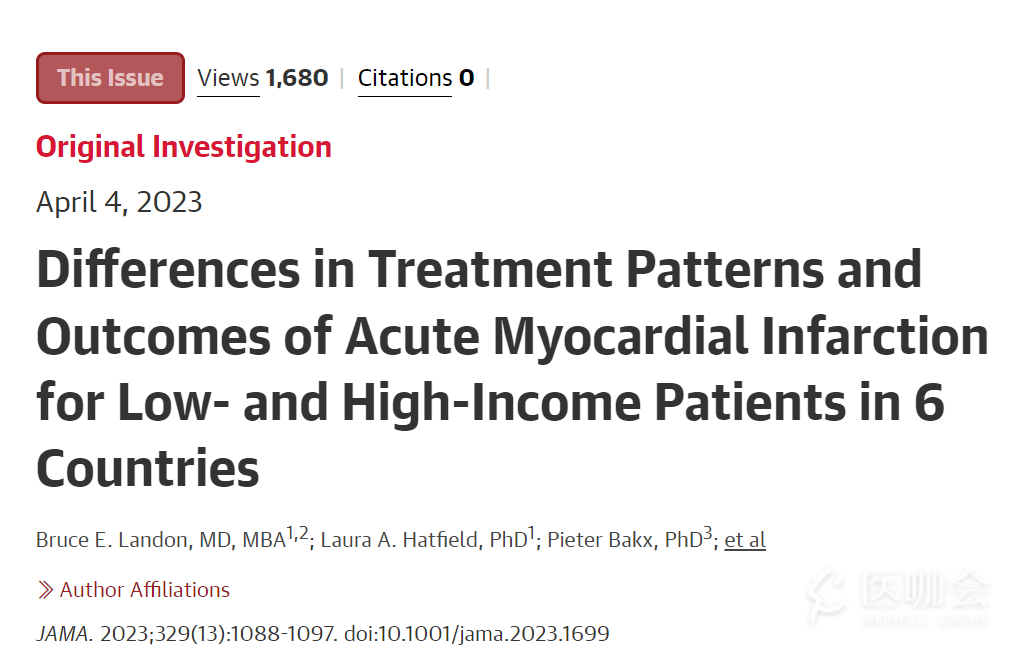
关键点内容如下:
要点
问题
在6个国家中,低收入和高收入个体对出现急性心肌梗死的老年患者的治疗模式和结果有何不同?
发现
在这项研究中,来自6个卫生系统的289376名年龄在66岁或以上的ST段抬高型心肌梗死(STEMI)住院患者和843046名非STEMI住院患者,低收入患者的校正30天和1年死亡率较高,而心导管插入术和经皮冠状动脉介入术的比率较低。高收入患者的住院时间更短,再入院率更低。
意义
这些结果表明,即使在拥有全民医疗保险和健全的社会安全网体系的国家,也存在基于收入的差异。
摘要内容如下:
重要性
卫生系统在组织和筹资方面的差异可能会对优势人群和弱势人群产生或多或少的公平结果。我们比较了6个国家的老年高收入和低收入患者的治疗和结果。
目标
确定6个国家低收入和高收入人群急性心肌梗死患者的治疗模式和结果是否不同。
研究对象
2013年至2018年在美国、加拿大、英国、荷兰、台湾和以色列对所有66岁或以上因急性心肌梗死住院的成年人进行的系列横断面队列研究,使用人群代表性管理数据。
暴露因素
在国家内部和国家之间处于收入最高和最低的五分之一。
主要结果和指标
30天和1年死亡率;次要转归包括心导管率和血运重建率、住院时间和再入院率。
结果
我们研究了289376例ST段抬高型心肌梗死(STEMI)住院患者和843046例非STEMI住院患者。对于高收入患者,调整后的30天死亡率通常低1至3个百分点。例如,荷兰ST段抬高型心肌梗死(STEMI)患者的30天死亡率,高收入者为10.2%,低收入者为13.1%(差异,-2.8个百分点[95%CI,-4.1至-1.5])。STEMI的1年死亡率差异甚至大于30天死亡率,以色列的差异最高(16.2%比25.3%;差异,−9.1个百分点[95%CI,−16.7至–1.6])。在所有国家中,高收入人群与低收入人群相比,心导管插入术和经皮冠状动脉介入术的比率更高,绝对差异为1至6个百分点(例如,73.6%对67.4%;英国经皮介入治疗STEMI的差异为6.1个百分点[95%CI,1.2至11.0])。ST段抬高型心肌梗死(STEMI)患者的冠状动脉旁路移植手术率在低收入阶层与高收入阶层相似,但在高收入患者中,NSTEMI患者的冠状动脉旁路移植手术率通常高出1至2个百分点(例如,美国为12.5%比11.0%;差异,1.5个百分点[95%CI,1.3至1.8])。高收入患者的30天再入院率通常也低1至3个百分点,住院时间通常短0.2至0.5天。
结论和相关性
在几乎所有国家,高收入人群的生存率更高,更有可能接受挽救生命的血运重建,住院时间更短,再入院率更低。我们的研究结果表明,即使在拥有全民医疗保险和健全的社会安全网体系的国家,也存在基于收入的差异。
英文原文如下:
Key Points
Question How do treatment patterns and outcomes for older patients presenting with acute myocardial infarction differ for low- vs high-income individuals across 6 countries.
Findings In this study of 289 376 patients aged 66 years or older hospitalized with ST-segment elevation myocardial infarction (STEMI) and 843 046 hospitalized with non-STEMI across 6 health systems, adjusted 30-day and 1-year mortality rates were higher for low-income patients, whereas rates of cardiac catheterization and percutaneous coronary interventions were lower. High-income patients also had shorter length of stay and lower rates of readmissions.
Meaning These results suggest that income-based disparities were present even in countries with universal health insurance and robust social safety net systems.
Abstract
Importance Differences in the organization and financing of health systems may produce more or less equitable outcomes for advantaged vs disadvantaged populations. We compared treatments and outcomes of older high- and low-income patients across 6 countries.
Objective To determine whether treatment patterns and outcomes for patients presenting with acute myocardial infarction differ for low- vs high-income individuals across 6 countries.
Design, Setting, and Participants Serial cross-sectional cohort study of all adults aged 66 years or older hospitalized with acute myocardial infarction from 2013 through 2018 in the US, Canada, England, the Netherlands, Taiwan, and Israel using population-representative administrative data.
Exposures Being in the top and bottom quintile of income within and across countries.
Main Outcomes and Measures Thirty-day and 1-year mortality; secondary outcomes included rates of cardiac catheterization and revascularization, length of stay, and readmission rates.
Results We studied 289 376 patients hospitalized with ST-segment elevation myocardial infarction (STEMI) and 843 046 hospitalized with non-STEMI (NSTEMI). Adjusted 30-day mortality generally was 1 to 3 percentage points lower for high-income patients. For instance, 30-day mortality among patients admitted with STEMI in the Netherlands was 10.2% for those with high income vs 13.1% for those with low income (difference, −2.8 percentage points [95% CI, −4.1 to −1.5]). One-year mortality differences for STEMI were even larger than 30-day mortality, with the highest difference in Israel (16.2% vs 25.3%; difference, −9.1 percentage points [95% CI, −16.7 to –1.6]). In all countries, rates of cardiac catheterization and percutaneous coronary intervention were higher among high- vs low-income populations, with absolute differences ranging from 1 to 6 percentage points (eg, 73.6% vs 67.4%; difference, 6.1 percentage points [95% CI, 1.2 to 11.0] for percutaneous intervention in England for STEMI). Rates of coronary artery bypass graft surgery for patients with STEMI in low- vs high-income strata were similar but for NSTEMI were generally 1 to 2 percentage points higher among high-income patients (eg, 12.5% vs 11.0% in the US; difference, 1.5 percentage points [95% CI, 1.3 to 1.8 ]). Thirty-day readmission rates generally also were 1 to 3 percentage points lower and hospital length of stay generally was 0.2 to 0.5 days shorter for high-income patients.
Conclusions and Relevance High-income individuals had substantially better survival and were more likely to receive lifesaving revascularization and had shorter hospital lengths of stay and fewer readmissions across almost all countries. Our results suggest that income-based disparities were present even in countries with universal health insurance and robust social safety net systems.