


JAMA:哌拉西林-他唑巴坦与头孢西丁预防胰十二指肠切除术后感染的随机对照临床试验
注:本文由小咖机器人翻译整理
期刊来源:JAMA
文献发表时间:2023-04-20
原文链接:https://jamanetwork.com/journals/jama/article-abstract/2804245
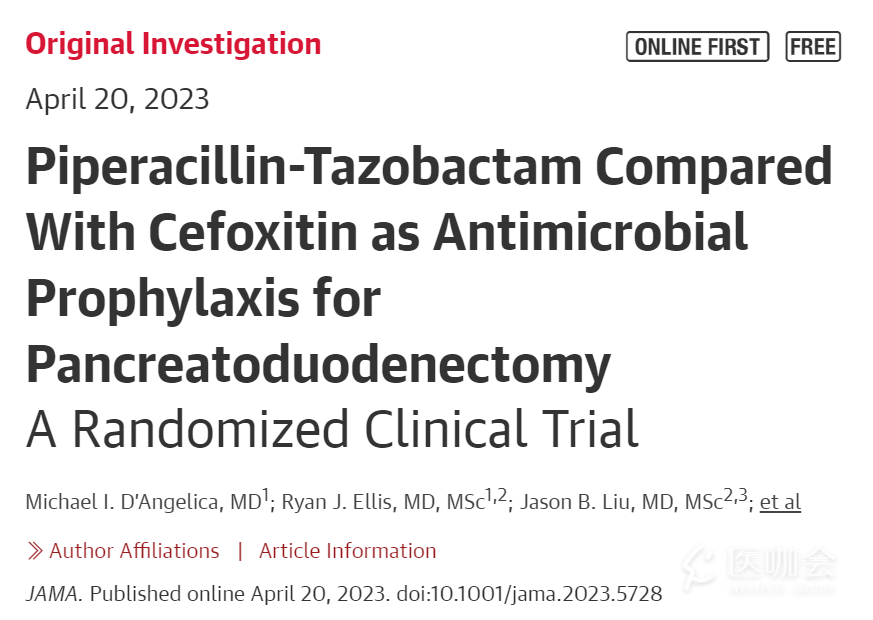
关键点内容如下:
问题
围手术期使用广谱抗生素能否减少开腹胰十二指肠切除术后手术部位感染?
调查结果
在这项实用的、开放标签的、注册相关的随机临床试验(包括来自北美的778名参与者)中,广谱哌拉西林-他唑巴坦组(19.8%)与标准治疗组头孢西丁组(32.8%)相比,术后30天手术部位感染患者的百分比在统计学上显著降低。
意义
研究结果支持使用哌拉西林-他唑巴坦作为开放性胰十二指肠切除术围手术期抗菌药物预防。
摘要内容如下:
重要性
尽管围手术期死亡率有所改善,但胰十二指肠切除术后手术部位感染(SSI)的发生率仍然很高。广谱抗菌药物在减少SSI的手术预防中的作用尚不明确。
目标
与标准护理抗生素相比,确定围术期广谱抗菌药物预防对术后SSI发生率的影响。
研究对象
在美国和加拿大的26家医院进行的实用、开放标签、多中心、随机3期临床试验。参与者在2017年11月至2021年8月期间入组,随访至2021年12月。因任何适应症而接受开放式胰十二指肠切除术的成人均符合条件。排除对研究药物过敏、活动性感染、长期使用类固醇、严重肾功能障碍或怀孕或哺乳的个体。参与者以1:1的比例被随机分组,并根据术前胆道支架的存在情况进行分层。分析试验数据的参与者、研究者和统计学家对治疗分配不设盲。
干预措施
干预组接受哌拉西林-他唑巴坦(3.375或4G,静脉注射)作为围手术期抗菌药物预防,对照组接受头孢西丁(2G,静脉注射,标准护理)。
主要结果和措施
要结果是术后30天内发生SSI.次要终点包括30天死亡率、发生临床相关的术后胰瘘和败血症。所有数据都是作为美国外科医师学会国家外科质量改进计划的一部分收集的。
结果
根据预先确定的终止规则,试验在中期分析时终止。
778名参与者(哌拉西林-他唑巴坦组378人[中位年龄66.8岁;男性233人(61.6%)]和头孢西丁组400人(中位年龄68.0岁;男性223人(55.8%)])中,哌拉西林/他唑巴坦组围术期SSI百分比低于头孢西丁(19.8%vs 32.8%;绝对差异−13.0%[95%CI,−19.1%至−6.9%]);P < .001). 与头孢西丁相比,接受哌拉西林-他唑巴坦治疗的参与者术后败血症发生率较低(4.2%vs 7.5%;差异为−3.3%[95%CI,−6.6%-0.0%];P = .02)和临床相关的术后胰瘘(12.7%vs 19.0%;差异,−6.3%[95%CI,−11.4%至−1.2%];P = .03). 接受哌拉西林-他唑巴坦治疗的参与者在30天时的死亡率为1.3%(5/378),接受头孢西丁治疗的参与者的死亡率为2.5%(10/400)(差异为-1.2%[95%CI,-3.1%-0.7%];P = .32)
结论和相关性
在接受开放式胰十二指肠切除术的参与者中,使用哌拉西林-他唑巴坦作为围手术期预防减少了术后SSI、胰瘘和SSI的多种下游后遗症。研究结果支持使用哌拉西林-他唑巴坦作为开放式胰十二指肠切除术的标准治疗。
英文原文如下:
Key Points
Question Does use of perioperative broad-spectrum antibiotics reduce postoperative surgical site infection after open pancreatoduodenectomy?
Findings In this pragmatic, open-label, registry-linked randomized clinical trial including 778 participants from North America, the percentage of patients with 30-day postoperative surgical site infection was statistically significantly reduced with broad-spectrum piperacillin-tazobactam (19.8%) vs standard care cefoxitin (32.8%).
Meaning The findings support the use of piperacillin-tazobactam as perioperative antimicrobial prophylaxis for open pancreatoduodenectomy.
Abstract
Importance Despite improvements in perioperative mortality, the incidence of postoperative surgical site infection (SSI) remains high after pancreatoduodenectomy. The effect of broad-spectrum antimicrobial surgical prophylaxis in reducing SSI is poorly understood.
Objective To define the effect of broad-spectrum perioperative antimicrobial prophylaxis on postoperative SSI incidence compared with standard care antibiotics.
Design, Setting, and Participants Pragmatic, open-label, multicenter, randomized phase 3 clinical trial at 26 hospitals across the US and Canada. Participants were enrolled between November 2017 and August 2021, with follow-up through December 2021. Adults undergoing open pancreatoduodenectomy for any indication were eligible. Individuals were excluded if they had allergies to study medications, active infections, chronic steroid use, significant kidney dysfunction, or were pregnant or breastfeeding. Participants were block randomized in a 1:1 ratio and stratified by the presence of a preoperative biliary stent. Participants, investigators, and statisticians analyzing trial data were unblinded to treatment assignment.
Intervention The intervention group received piperacillin-tazobactam (3.375 or 4 g intravenously) as perioperative antimicrobial prophylaxis, while the control group received cefoxitin (2 g intravenously; standard care).
Main Outcomes and Measures The primary outcome was development of postoperative SSI within 30 days. Secondary end points included 30-day mortality, development of clinically relevant postoperative pancreatic fistula, and sepsis. All data were collected as part of the American College of Surgeons National Surgical Quality Improvement Program.
Results The trial was terminated at an interim analysis on the basis of a predefined stopping rule. Of 778 participants (378 in the piperacillin-tazobactam group [median age, 66.8 y; 233 {61.6%} men] and 400 in the cefoxitin group [median age, 68.0 y; 223 {55.8%} men]), the percentage with SSI at 30 days was lower in the perioperative piperacillin-tazobactam vs cefoxitin group (19.8% vs 32.8%; absolute difference, −13.0% [95% CI, −19.1% to −6.9%]; P < .001). Participants treated with piperacillin-tazobactam, vs cefoxitin, had lower rates of postoperative sepsis (4.2% vs 7.5%; difference, −3.3% [95% CI, −6.6% to 0.0%]; P = .02) and clinically relevant postoperative pancreatic fistula (12.7% vs 19.0%; difference, −6.3% [95% CI, −11.4% to −1.2%]; P = .03). Mortality rates at 30 days were 1.3% (5/378) among participants treated with piperacillin-tazobactam and 2.5% (10/400) among those receiving cefoxitin (difference, −1.2% [95% CI, −3.1% to 0.7%]; P = .32).
Conclusions and Relevance In participants undergoing open pancreatoduodenectomy, use of piperacillin-tazobactam as perioperative prophylaxis reduced postoperative SSI, pancreatic fistula, and multiple downstream sequelae of SSI. The findings support the use of piperacillin-tazobactam as standard care for open pancreatoduodenectomy.