


JAMA:2011-2020年青少年心理健康相关急诊就诊的全国趋势
注:本文由小咖机器人翻译整理
期刊来源:JAMA
文献发表时间:2023-05-02
原文链接:https://jamanetwork.com/journals/jama/article-abstract/2804326
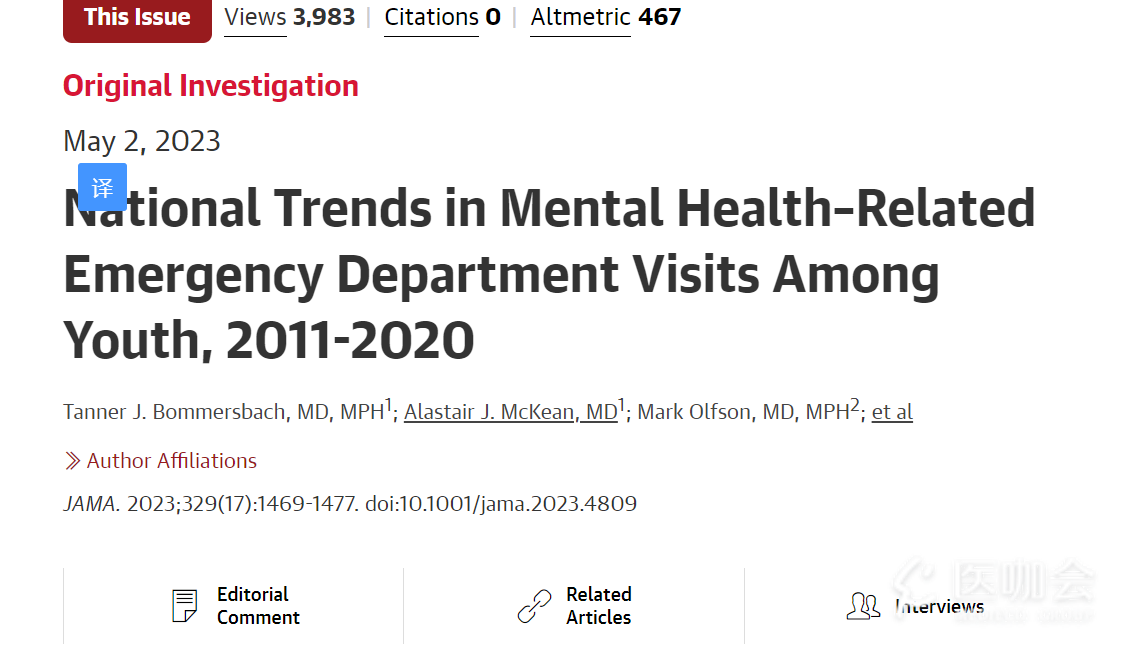
关键点内容如下:
问题
从2011年到2020年,儿童、青少年和年轻人中与精神健康相关的急诊科(ED)就诊的全国趋势是什么?
调查结果
从2011年到2020年,儿科和年轻成人急诊就诊的总人数保持相对稳定,但因精神健康原因就诊的比例大约增加了一倍,其中因自杀相关症状就诊的比例增加了5倍。
意义
这些研究结果表明,迫切需要扩大紧急和危机服务,以解决儿科心理健康问题,特别是自杀症状。
摘要内容如下:
重要性
特别是自COVID-19大流行以来,人们越来越关注青少年心理健康问题的负担。精神卫生相关的急诊科(ED)就诊趋势是未满足的门诊精神卫生需求的重要指标。
目标
评估2011年至2020年美国儿童、青少年和年轻人心理健康相关急诊就诊的年度趋势。
研究对象
国家医院门诊医疗护理调查(一项关于急诊的年度全国横断面概率抽样调查)中2011年至2020年的数据用于检查6至24岁青少年(未加权=49515)的心理健康相关就诊。
主要结果和措施
与精神健康相关的急诊就诊包括与精神或物质使用障碍相关的就诊,并通过国际疾病分类第九版,临床修订(ICD-9-CM确定。2011-2015)和ICD-10-CM(2016-2020)出院诊断代码或按就诊原因(RFV)代码。我们估计了2011年至2020年与精神健康相关的儿科急诊就诊的年度比例。根据人口统计学和广泛的精神病学诊断进行亚组分析。多变量调整的逻辑回归分析估计了与精神健康相关的ED就诊独立相关的因素,控制了期间效应。
结果
从2011年到2020年,儿科精神健康相关就诊的加权数量从480万(占所有儿科急诊就诊的7.7%)增加到750万(占所有急诊就诊的13.1%),年均百分比变化为8.0%(95%CI,6.1%-10.1%;P<.001)。在儿童、青少年和年轻成年人中发现了显著的线性增长趋势,在青少年中以及在性别、种族和民族中增长最快。虽然所有类型的心理健康相关就诊显著增加,但自杀相关就诊的增幅最大,从所有儿科急诊就诊的0.9%增加到4.2%,(平均年度百分比变化23.1%[95%CI,19.0%-27.5%];P<.001)。
结论和相关性
在过去10年中,因精神健康原因而到儿科急诊就诊的比例大约翻了一番,其中与自杀有关的就诊增加了5倍。这些研究结果强调,迫切需要提高年轻人的危机和紧急心理健康服务能力,特别是经历自杀症状的儿童。
英文原文如下:
Key Points
Question What are national trends in mental health–related emergency department (ED) visits among children, adolescents, and young adults from 2011 to 2020?
Findings While the total number of pediatric and young adult ED visits has remained relatively stable from 2011 to 2020, the proportion of visits for mental health reasons has approximately doubled, including a 5-fold increase in the proportion of visits for suicide-related symptoms.
Meaning These findings suggest an urgent need to expand emergency and crisis services to address pediatric mental health concerns, especially for suicidal symptoms.
Abstract
Importance There has been increasing concern about the burden of mental health problems among youth, especially since the COVID-19 pandemic. Trends in mental health–related emergency department (ED) visits are an important indicator of unmet outpatient mental health needs.
Objective To estimate annual trends in mental health–related ED visits among US children, adolescents, and young adults between 2011 and 2020.
Design, Setting, and Participants Data from 2011 to 2020 in the National Hospital Ambulatory Medical Care Survey, an annual cross-sectional national probability sample survey of EDs, was used to examine mental health–related visits for youths aged 6 to 24 years (unweighted = 49 515).
Main Outcomes and Measures Mental health–related ED visits included visits associated with psychiatric or substance use disorders and were identified by International Classification of Diseases-Ninth Revision, Clinical Modification (ICD-9-CM; 2011-2015) and ICD-10-CM (2016-2020) discharge diagnosis codes or by reason-for-visit (RFV) codes. We estimated the annual proportion of mental health–related pediatric ED visits from 2011 to 2020. Subgroup analyses were performed by demographics and broad psychiatric diagnoses. Multivariable-adjusted logistic regression analyses estimated factors independently associated with mental health–related ED visits controlling for period effects.
Results From 2011 to 2020, the weighted number of pediatric mental health–related visits increased from 4.8 million (7.7% of all pediatric ED visits) to 7.5 million (13.1% of all ED visits) with an average annual percent change of 8.0% (95% CI, 6.1%-10.1%; P < .001). Significant linearly increasing trends were seen among children, adolescents, and young adults, with the greatest increase among adolescents and across sex and race and ethnicity. While all types of mental health–related visits significantly increased, suicide-related visits demonstrated the greatest increase from 0.9% to 4.2% of all pediatric ED visits (average annual percent change, 23.1% [95% CI, 19.0%-27.5%]; P < .001).
Conclusions and Relevance Over the last 10 years, the proportion of pediatric ED visits for mental health reasons has approximately doubled, including a 5-fold increase in suicide-related visits. These findings underscore an urgent need to improve crisis and emergency mental health service capacity for young people, especially for children experiencing suicidal symptoms.