


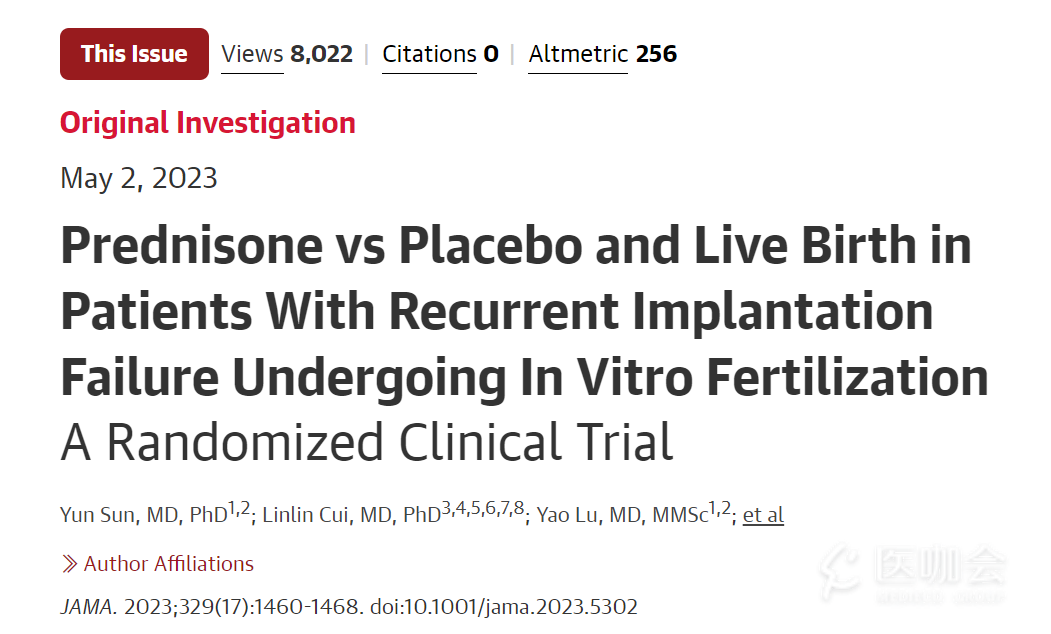
JAMA:接受体外受精的复发性种植失败患者中泼尼松与安慰剂和活产的比较:一项随机临床试验
注:本文由小咖机器人翻译整理
期刊来源:JAMA
文献发表时间:2023-05-02
原文链接:https://jamanetwork.com/journals/jama/article-abstract/2804325
关键点内容如下:
问题
与安慰剂相比,使用10mg强的松是否能提高复发性着床失败妇女的活产机会?
调查结果
在这项随机临床试验中,715名妇女经历了2个或2个以上不成功的胚胎移植周期,接受10mg强的松的妇女的活产率为37.8%,而接受安慰剂的妇女的活产率为38.8%,无显著差异。
意义
这意味着研究结果不支持在复发性植入失败的妇女中常规使用10mg泼尼松。
摘要内容如下:
重要性
植入失败仍然是体外受精的关键障碍。泼尼松作为一种免疫调节剂,广泛用于提高着床率和妊娠率,但疗效证据不足。
目标
确定10 mg泼尼松与安慰剂对复发性着床失败妇女活产的疗效。
研究对象
一项在中国8个生育中心进行的双盲、安慰剂对照、随机临床试验。从2018年11月至2020年8月(最终随访于2021年8月),招募了符合条件的妇女,这些妇女有2个或2个以上不成功的胚胎移植周期,取卵时年龄小于38岁,并计划进行冻融胚胎移植,以获得高质量的胚胎。
干预措施
受试者随机(1:1)接受口服含10 mg泼尼松(n=357)或匹配安慰剂(n=358)的药丸,每日一次,从他们开始为冻融胚胎移植做子宫内膜准备之日起至早孕。
主要结果
主要结果是活产,即分娩任何数量的在妊娠28周或28周以上出生的有生命迹象的新生儿。
结果
在随机分配的715名妇女(平均年龄32岁)中,714名(99.9%)有活产结局的可用数据,并被纳入主要分析。泼尼松组37.8%的妇女(357名)中有135名活产,安慰剂组38.8%的妇女(358名)中有139名活产(绝对差异,-1.0%[95%CI,-8.1%至6.1%];相对比率[RR],0.97[95%CI,0.81至1.17];P=.78)。生化妊娠丢失率在泼尼松组中为17.3%,在安慰剂组中为9.9%(绝对差异,7.5%[95%CI,0.6%-14.3%];RR,1.75[95%CI,1.03~2.99];P=.04)。泼尼松组早产发生率为11.8%,安慰剂组为5.5%(绝对差异为6.3%[95%CI为0.2%-12.4%];RR,2.14[95%CI,1.00~4.58];P=.04)。在生化妊娠、临床妊娠、着床、新生儿并发症、先天性异常、其他不良事件或平均出生体重的发生率方面,组间差异无统计学意义。
结论和相关性
在复发性植入失败患者中,与安慰剂相比,泼尼松治疗并没有提高活产率。数据表明,使用泼尼松可能会增加早产和生化妊娠损失的风险。我们的研究结果对泼尼松在临床实践中治疗复发性植入失败的价值提出了质疑。
英文原文如下:
Key Points
Question Does the use of 10 mg of prednisone, compared with placebo, improve the chances of achieving live birth among women with recurrent implantation failure?
Findings In this randomized clinical trial that included 715 women who had experienced 2 or more unsuccessful embryo transfer cycles, the live birth rate was 37.8% among women who received 10 mg of prednisone vs 38.8% among women who received placebo, a nonsignificant difference.
Meaning The findings do not support the routine use of 10 mg of prednisone in women with recurrent implantation failure.
Abstract
Importance Implantation failure remains a critical barrier to in vitro fertilization. Prednisone, as an immune-regulatory agent, is widely used to improve the probability of implantation and pregnancy, although the evidence for efficacy is inadequate.
Objective To determine the efficacy of 10 mg of prednisone compared with placebo on live birth among women with recurrent implantation failure.
Design, Setting, and Participants A double-blind, placebo-controlled, randomized clinical trial conducted at 8 fertility centers in China. Eligible women who had a history of 2 or more unsuccessful embryo transfer cycles, were younger than 38 years when oocytes were retrieved, and were planning to undergo frozen-thawed embryo transfer with the availability of good-quality embryos were enrolled from November 2018 to August 2020 (final follow-up August 2021).
Interventions Participants were randomized (1:1) to receive oral pills containing either 10 mg of prednisone (n = 357) or matching placebo (n = 358) once daily, from the day at which they started endometrial preparation for frozen-thawed embryo transfer through early pregnancy.
Main Outcomes and Measures The primary outcome was live birth, defined as the delivery of any number of neonates born at 28 or more weeks’ gestation with signs of life.
Results Among 715 women randomized (mean age, 32 years), 714 (99.9%) had data available on live birth outcomes and were included in the primary analysis. Live birth occurred among 37.8% of women (135 of 357) in the prednisone group vs 38.8% of women (139 of 358) in the placebo group (absolute difference, −1.0% [95% CI, −8.1% to 6.1%]; relative ratio [RR], 0.97 [95% CI, 0.81 to 1.17]; P = .78). The rates of biochemical pregnancy loss were 17.3% in the prednisone group and 9.9% in the placebo group (absolute difference, 7.5% [95% CI, 0.6% to 14.3%]; RR, 1.75 [95% CI, 1.03 to 2.99]; P = .04). Of those in the prednisone group, preterm delivery occurred among 11.8% and of those in the placebo group, 5.5% of pregnancies (absolute difference, 6.3% [95% CI, 0.2% to 12.4%]; RR, 2.14 [95% CI, 1.00 to 4.58]; P = .04). There were no statistically significant between-group differences in the rates of biochemical pregnancy, clinical pregnancy, implantation, neonatal complications, congenital anomalies, other adverse events, or mean birthweights.
Conclusions and Relevance Among patients with recurrent implantation failure, treatment with prednisone did not improve live birth rate compared with placebo. Data suggested that the use of prednisone may increase the risk of preterm delivery and biochemical pregnancy loss. Our results challenge the value of prednisone use in clinical practice for the treatment of recurrent implantation failure.