


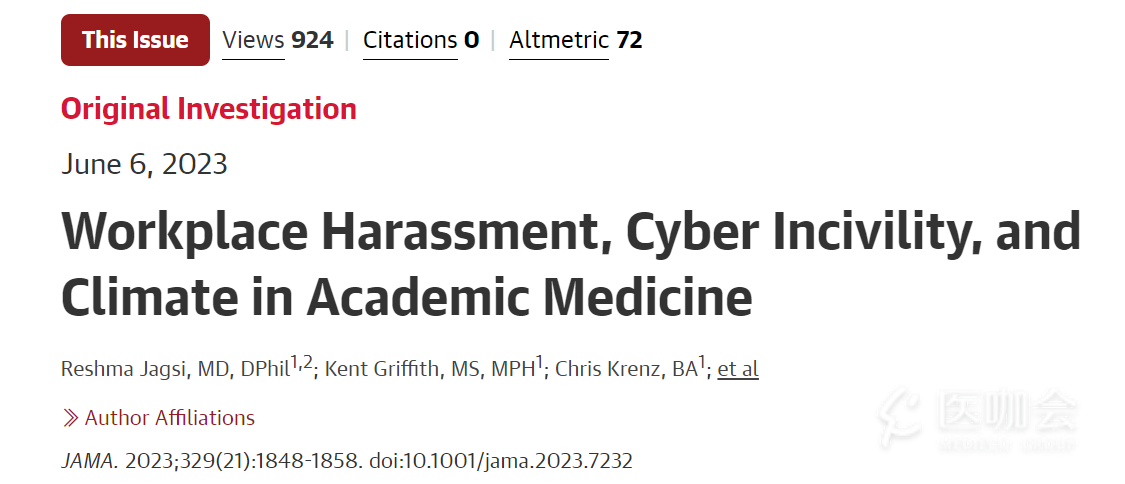
JAMA:工作场所骚扰、网络不文明行为与医学学术氛围
本文由小咖机器人翻译整理
期刊来源:JAMA
文献发表时间:2023-06-06
原文链接:https://jamanetwork.com/journals/jama/article-abstract/2805706
关键点内容如下:
问题
反映学术医学文化的经历(性骚扰、网络不文明和对气候的正面或负面看法)是否因性别、种族和民族以及女同性恋、男同性恋、双性恋、变性人、酷儿身份而不同?这些因素是否与教师心理健康有关?
调查结果
在这项对获得美国国立卫生研究院(NIH)K08或K23职业发展补助金的临床研究人员的调查中,性骚扰、网络不文明和对气候的负面看法的发生率令人担忧,这些经历与较差的心理健康状况有关。
意义
学术医学中存在一个文化问题,对妇女和其他来自系统边缘化人群的人产生了不成比例的影响,这表明医疗行业需要不断进行文化转型。
摘要内容如下:
重要性
学术医学的文化可能会助长虐待,不成比例地影响在特定社会中被边缘化的个人(少数群体),并损害劳动力的活力。现有的研究因缺乏全面、有效的测量方法、低应答率、样本狭窄以及仅限于出生时指定的男性或女性(顺性别)的二元性别类别的比较而受到限制。
目标
评估学术医学文化、教师心理健康及其关系。
研究对象
2006-2009年,美国共有830名教师获得了国立卫生研究院职业发展奖,留在学术界,并对2021年的调查做出了回应,回复率为64%。按性别、种族和民族(使用亚洲人、医学中代表性不足[定义为除亚洲或非西班牙裔白人以外的种族和民族]和白人)以及女同性恋、男同性恋、双性恋、变性人、酷儿(LGBTQ+)身份进行比较。使用多变量模型来探索文化经历(气候、性骚扰和网络不文明)与心理健康之间的联系。
暴露因素
基于性别、种族和民族以及LGBTQ+身份的少数族裔身份。
主要结果和措施
文化的三个方面被测量为主要结果:组织氛围、性骚扰和网络不文明,使用先前开发的工具。采用5项心理健康量表(分值0~100分,分值越高表示心理健康状况越好)评估心理健康的次要结果。
结果
在830名教师中,有422名男性,385名女性,2名非二元性别,21名未确定性别。有169名亚裔受访者,66名受访者在医学领域的代表性不足,572名白人受访者,23名受访者没有报告他们的种族和民族。有774名受访者认为自己是顺性别者和异性恋者,31人认为自己有LGBTQ+身份,25人认为自己没有身份。女性对总体气氛(5分制)的负面评价高于男性(平均值分别为3.68[95%CI,3.59-3.77]和3.96[95%CI,3.88-4.04],P.001)。多样性氛围评级在性别(平均值方面存在显著差异,女性为3.72[95%CI,3.64-3.80],男性为4.16[95%CI,4.09-4.23],P.001);在种族和民族(平均值方面存在显著差异,亚洲受访者为4.0[95%置信区间,3.88-4.12],在医学领域代表性不足的受访者为3.71[95%置信区间,P=.04)。女性比男性更有可能报告遭受性别骚扰(性别歧视言论和粗鲁行为)(分别为71.9%[95%CI,67.1%-76.4%]和44.9%[95%CI,40.1%-49.8%],P<.001)。在专业使用社交媒体时,LGBTQ+身份的受访者比顺性别者和异性恋者更有可能报告遭受性骚扰(分别为13.3%[95%CI,1.7%-40.5%]和2.5%[95%CI,1.2%-4.6%],P=0.01)。在多变量分析中,文化和性别的3个方面均与心理健康的次要结果显著相关。
结论和相关性
性骚扰、网络不文明和负面组织氛围在学术医学领域的发生率很高,对少数群体和心理健康的影响尤为严重。有必要继续努力改变文化。
英文原文如下:
Key Points
Question Do experiences that reflect the culture of academic medicine (sexual harassment, cyber incivility, and positive or negative perceptions of climate) differ by gender, race and ethnicity, and lesbian, gay, bisexual, transgender, queer status, and are these factors associated with faculty mental health?
Findings In this survey of clinician-researchers who received K08 or K23 career development grants from the National Institutes of Health, there were concerning rates of sexual harassment, cyber incivility, and negative perceptions of climate, which were experiences that were associated with poorer mental health.
Meaning A cultural problem exists in academic medicine that disproportionately affects women and others from systematically marginalized populations, indicating an ongoing need for cultural transformation in the medical profession.
Abstract
Importance The culture of academic medicine may foster mistreatment that disproportionately affects individuals who have been marginalized within a given society (minoritized groups) and compromises workforce vitality. Existing research has been limited by a lack of comprehensive, validated measures, low response rates, and narrow samples as well as comparisons limited to the binary gender categories of male or female assigned at birth (cisgender).
Objective To evaluate academic medical culture, faculty mental health, and their relationship.
Design, Setting, and Participants A total of 830 faculty members in the US received National Institutes of Health career development awards from 2006-2009, remained in academia, and responded to a 2021 survey that had a response rate of 64%. Experiences were compared by gender, race and ethnicity (using the categories of Asian, underrepresented in medicine [defined as race and ethnicity other than Asian or non-Hispanic White], and White), and lesbian, gay, bisexual, transgender, queer (LGBTQ+) status. Multivariable models were used to explore associations between experiences of culture (climate, sexual harassment, and cyber incivility) with mental health.
Exposures Minoritized identity based on gender, race and ethnicity, and LGBTQ+ status.
Main Outcomes and Measures Three aspects of culture were measured as the primary outcomes: organizational climate, sexual harassment, and cyber incivility using previously developed instruments. The 5-item Mental Health Inventory (scored from 0 to 100 points with higher values indicating better mental health) was used to evaluate the secondary outcome of mental health.
Results Of the 830 faculty members, there were 422 men, 385 women, 2 in nonbinary gender category, and 21 who did not identify gender; there were 169 Asian respondents, 66 respondents underrepresented in medicine, 572 White respondents, and 23 respondents who did not report their race and ethnicity; and there were 774 respondents who identified as cisgender and heterosexual, 31 as having LGBTQ+ status, and 25 who did not identify status. Women rated general climate (5-point scale) more negatively than men (mean, 3.68 [95% CI, 3.59-3.77] vs 3.96 [95% CI, 3.88-4.04], respectively, P < .001). Diversity climate ratings differed significantly by gender (mean, 3.72 [95% CI, 3.64-3.80] for women vs 4.16 [95% CI, 4.09-4.23] for men, P < .001) and by race and ethnicity (mean, 4.0 [95% CI, 3.88-4.12] for Asian respondents, 3.71 [95% CI, 3.50-3.92] for respondents underrepresented in medicine, and 3.96 [95% CI, 3.90-4.02] for White respondents, P = .04). Women were more likely than men to report experiencing gender harassment (sexist remarks and crude behaviors) (71.9% [95% CI, 67.1%-76.4%] vs 44.9% [95% CI, 40.1%-49.8%], respectively, P < .001). Respondents with LGBTQ+ status were more likely to report experiencing sexual harassment than cisgender and heterosexual respondents when using social media professionally (13.3% [95% CI, 1.7%-40.5%] vs 2.5% [95% CI, 1.2%-4.6%], respectively, P = .01). Each of the 3 aspects of culture and gender were significantly associated with the secondary outcome of mental health in the multivariable analysis.
Conclusions and Relevance High rates of sexual harassment, cyber incivility, and negative organizational climate exist in academic medicine, disproportionately affecting minoritized groups and affecting mental health. Ongoing efforts to transform culture are necessary.